
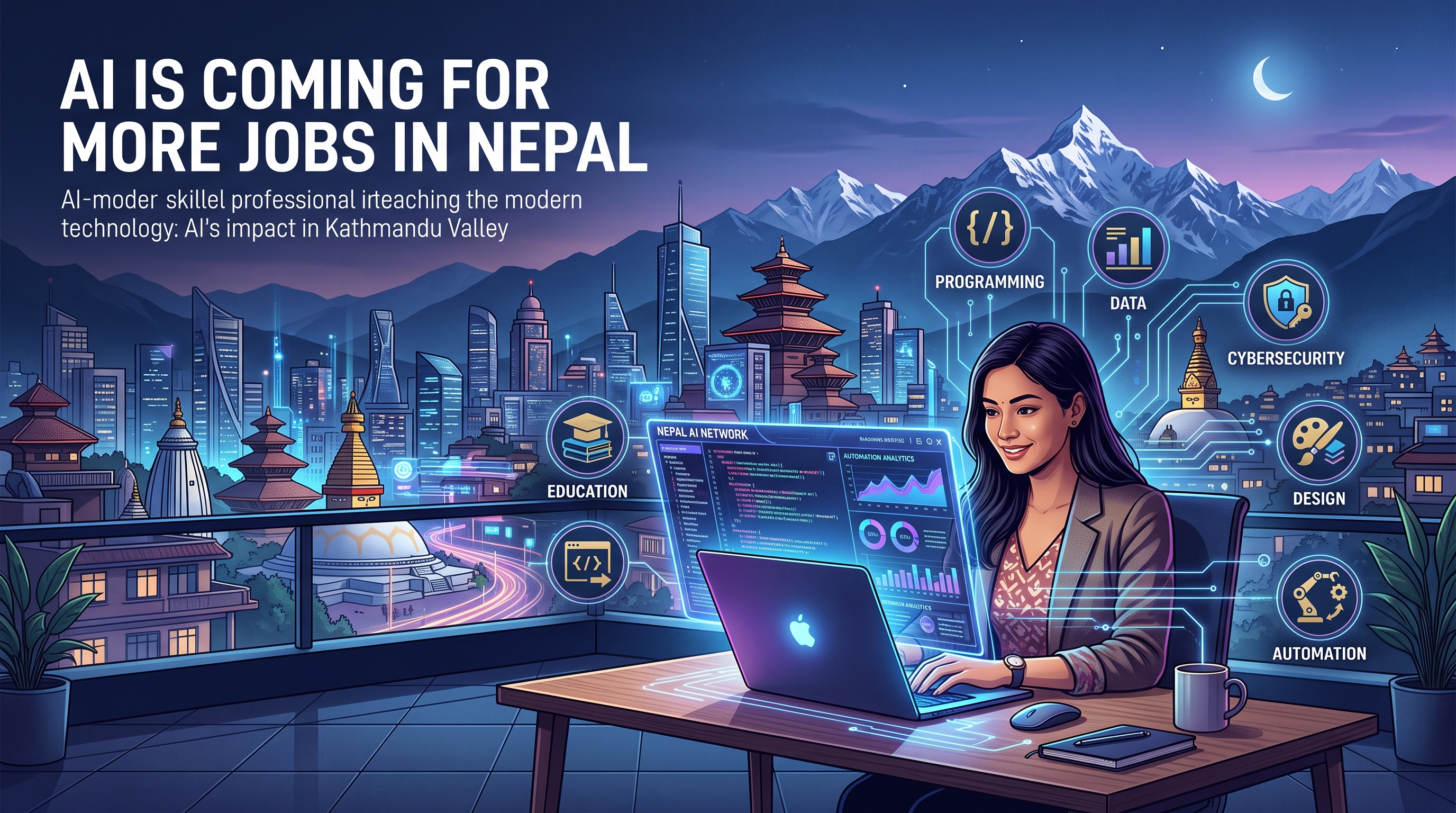
Artificial intelligence is no longer something that belongs only to Silicon Valley. AI tools are increasingly being used for writing, design, customer support, data analysis, programming, education and business operations. For workers in Nepal, the important question is no longer simply “Will AI take my job?” but rather:
“Which parts of my job can AI automate, and which skills will make me more valuable?”
Nepal has already recognized the importance of artificial intelligence through its National AI Policy 2082, which identifies skilled human resources, infrastructure, data and investment as important challenges for the country's AI development. The policy also acknowledges that AI adoption could reduce some existing jobs and emphasizes the need to prepare for its impact.
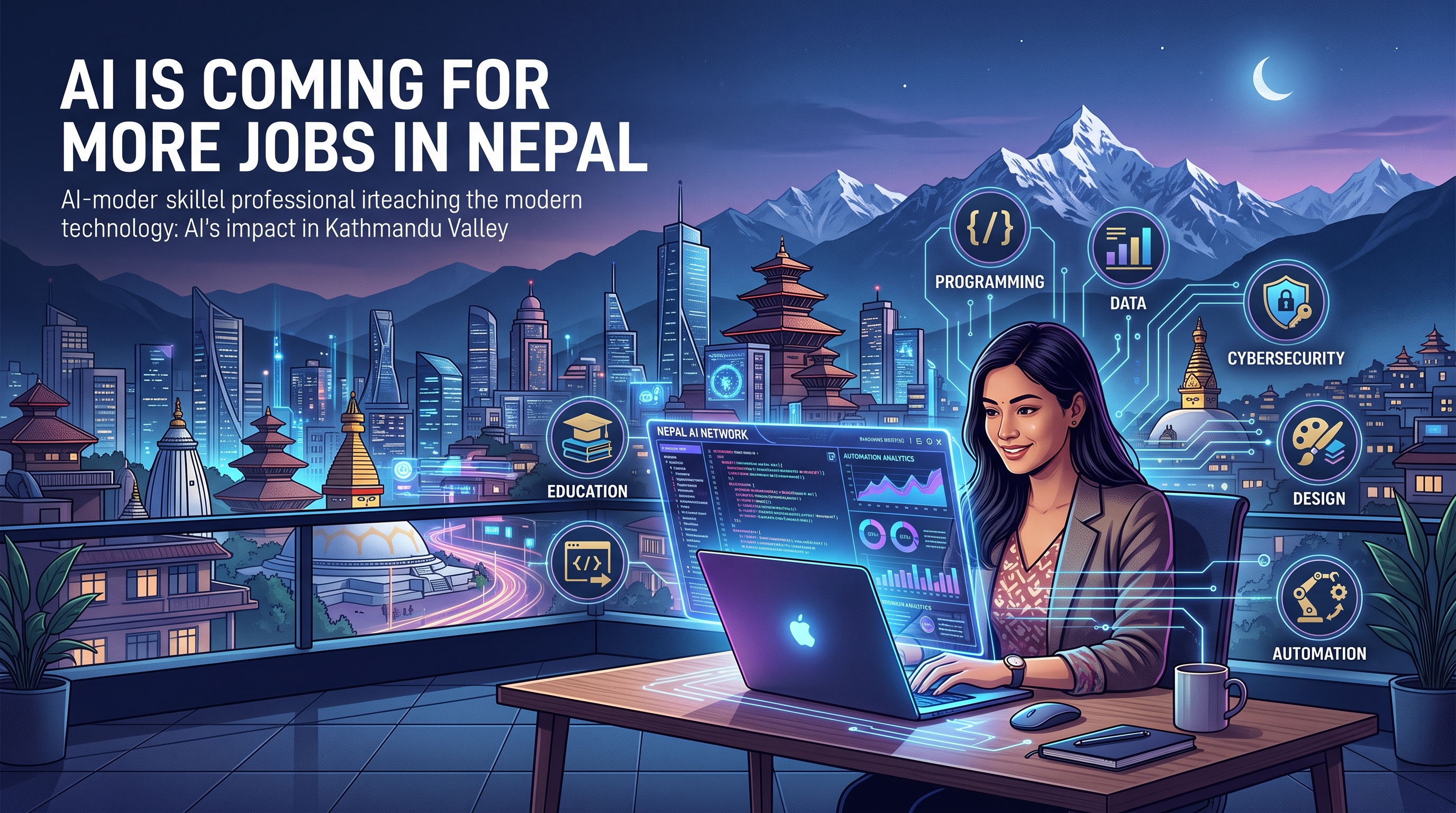
AI May Change Jobs Before It Eliminates Them
One common misconception is that AI will immediately replace entire professions.
In reality, AI is often more effective at automating specific tasks rather than complete occupations.
For example, a marketing employee may use AI to generate a first draft of an article. A programmer can use AI to produce routine code. A teacher can use AI to prepare lesson plans and quizzes. An accountant can automate parts of data processing.
The person may still be needed—but the way they work changes.
The World Economic Forum's Future of Jobs Report 2025 estimates that around 39% of workers' existing skill sets could be transformed or become outdated by 2030. At the same time, the report projects 170 million new jobs and 92 million displaced jobs globally, resulting in a net increase of 78 million jobs.
That means the bigger risk for many workers may not be AI replacing them, but another worker who knows how to use AI replacing them.
Which Skills Will Become More Important?
The World Economic Forum identifies AI and big data as the fastest-growing skill area, followed by networks and cybersecurity and technological literacy. But technical skills alone are not enough.
Creative thinking, analytical thinking, resilience, flexibility, curiosity and lifelong learning are also expected to become increasingly important.
For workers in Nepal, five skill categories deserve particular attention.
1. AI Literacy
You do not necessarily need to become an AI engineer.
The first step is learning how to use AI tools effectively.
This includes:
- Writing effective prompts
- Using AI for research
- Checking AI-generated information
- Automating repetitive tasks
- Using AI for writing and editing
- Understanding AI limitations
- Protecting private and sensitive information
AI literacy could become as important as basic computer literacy in many workplaces.
2. Data and Digital Skills
AI depends heavily on data.
Learning skills such as:
- Excel and Google Sheets
- SQL
- Data visualization
- Basic statistics
- Data cleaning
- Database fundamentals
can create opportunities beyond traditional office work.
Someone who can understand business data and use AI to analyze it can potentially be much more productive than someone who only knows one of those areas.
3. Programming and Automation
Programming is not disappearing because of AI.
Instead, the nature of programming is changing.
AI coding assistants can generate routine code, but developers still need to understand architecture, debugging, databases, security and business requirements.
For beginners, useful areas include:
- Python
- JavaScript
- SQL
- APIs
- Django or other web frameworks
- Automation
- Git and GitHub
The goal should not be to compete with AI at typing code. The goal should be to use AI to build better software faster.
4. Cybersecurity
As organizations become more dependent on digital systems and AI, cybersecurity becomes increasingly important.
Nepal's National AI Policy itself identifies data security, privacy and responsible AI use among the country's challenges.
Useful skills include:
- Network fundamentals
- Linux
- Web security
- Cloud security
- Data protection
- Secure coding
- Basic ethical hacking
Cybersecurity is also identified by the World Economic Forum as one of the fastest-growing skill areas.
5. Human Skills
This is the part many people overlook.
AI can generate text, images, code and analysis, but humans still need to make decisions, communicate with customers, understand context and take responsibility for outcomes.
Skills such as:
- Critical thinking
- Communication
- Leadership
- Creativity
- Problem solving
- Collaboration
- Adaptability
will remain valuable.
The World Economic Forum specifically lists creative thinking, resilience, flexibility, agility, curiosity and lifelong learning among the skills increasing in importance.
What About Teachers in Nepal?
Education is one area where AI could significantly change daily work.
Teachers may increasingly use AI to:
- Create lesson plans
- Generate practice questions
- Prepare teaching materials
- Translate content
- Analyze student performance
- Create personalized learning activities
But this does not mean teachers become unnecessary.
A teacher still needs to understand students, manage a classroom, identify learning difficulties, motivate students and make professional judgments.
The future teacher may therefore be less focused on manually creating every piece of material and more focused on using technology to improve learning.
What About Graphic Designers?
Graphic design is another profession facing significant AI disruption.
Generative AI can already produce images, concepts, layouts and marketing materials very quickly.
The World Economic Forum even lists graphic designers among roles expected to decline as generative AI reshapes the labour market.
That does not necessarily mean design disappears.
Instead, designers may need to move toward:
- UI/UX design
- Brand strategy
- Art direction
- Product design
- Design systems
- User research
- AI-assisted creative workflows
The designer who only produces basic social-media graphics may face more competition than the designer who understands users, products and business objectives.
What Should Nepali Students Learn?
Students should avoid chasing every new AI tool.
A better strategy is to build a strong foundation first.
Beginner
Learn:
Computer fundamentals → English communication → AI literacy → Excel/Sheets → Internet and digital tools
Intermediate
Add:
Python → SQL → Git/GitHub → APIs → Data analysis → AI-assisted productivity
Advanced
Choose a specialization:
AI/ML | Software Development | Cybersecurity | Data | UI/UX | Cloud | Automation
This approach is more sustainable than simply learning how to use the latest AI chatbot.
The Biggest Opportunity May Be AI + Existing Skills
One of the strongest strategies for Nepal could be combining AI with an existing profession.
For example:
Teacher + AI → EdTech specialist
Accountant + AI → Automated financial reporting
Designer + AI → AI-assisted product designer
Developer + AI → AI-powered software developer
Marketer + AI → AI-driven digital marketer
Agriculture + AI → Smart agriculture services
Tourism + AI → AI-powered travel services
The advantage comes from combining domain knowledge + technology, rather than trying to become an AI researcher overnight.
So, Will AI Take Jobs in Nepal?
Some jobs and tasks will undoubtedly be automated or reduced.
But saying “AI will take everyone's jobs” is too simplistic.
The more realistic scenario is that the labour market will change.
Routine and repetitive digital tasks are likely to face greater automation pressure, while roles requiring judgment, human interaction, physical work, specialized expertise and responsibility may remain more resilient.
The World Economic Forum estimates that 59 out of every 100 workers could require training or upskilling by 2030 as skills requirements change.
For Nepal, this creates both a challenge and an opportunity.
The country needs people who understand technology—but it also needs teachers, healthcare workers, entrepreneurs, technicians, farmers, designers, managers and other professionals who know how to use technology effectively in their own fields.
What Should You Do Now?
You do not need to panic about AI.
But you should not ignore it either.
Start by asking three questions:
1. What repetitive tasks do I perform every week?
2. Can AI help me perform them faster?
3. What human skills can I develop that AI cannot easily replace?
Then start learning.
Spend less time worrying about whether AI will take your job and more time learning how to work with AI.
The future may not belong to people who know everything about artificial intelligence.
It may belong to people who know how to combine AI with valuable human skills.