
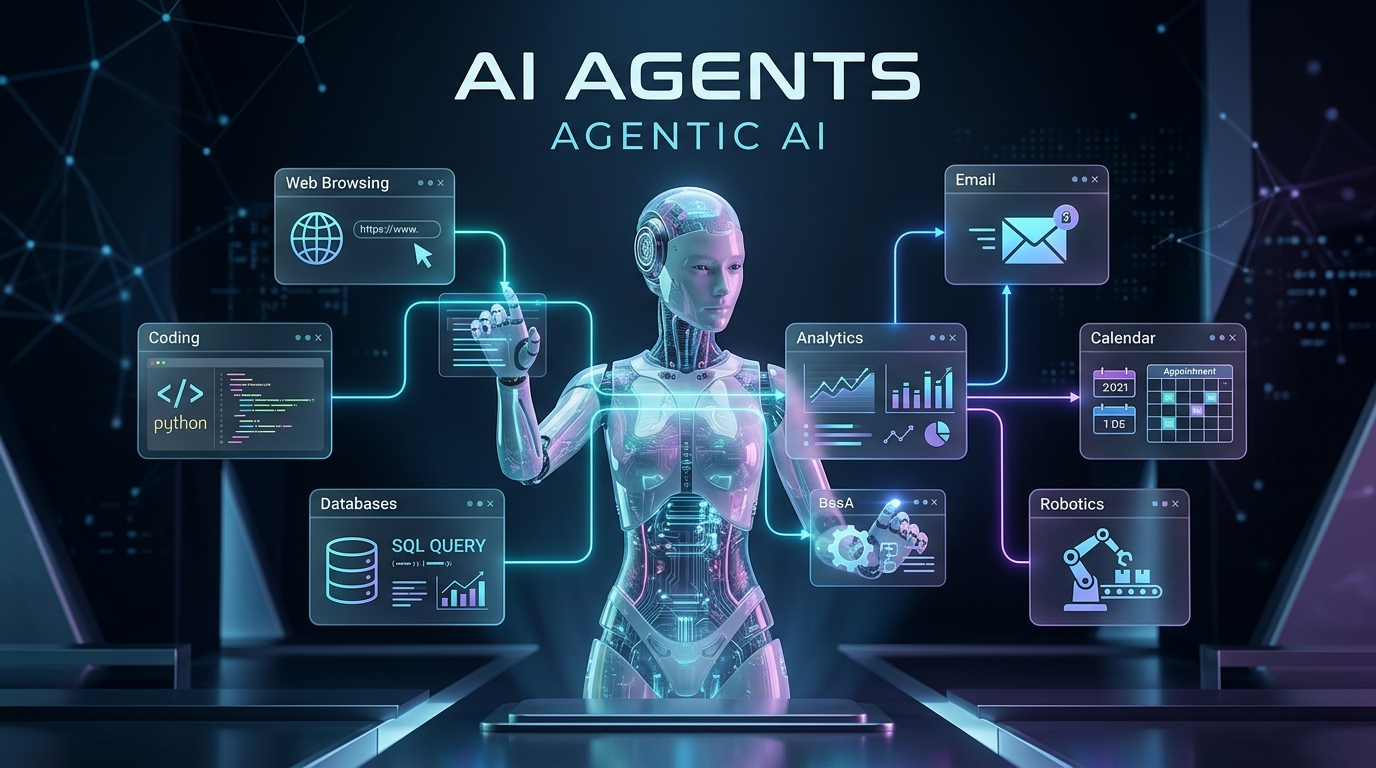
For the past few years, people have mainly used AI tools to ask questions, generate text, create images, write code, and summarize information. But a new generation of AI is emerging that can do much more: AI agents can plan tasks, make decisions, use tools, and take actions on behalf of users.
This technology is commonly called Agentic AI or AI Agents, and it is becoming one of the most important developments in artificial intelligence.
What Are AI Agents?
An AI agent is a software system powered by artificial intelligence that can work toward a specific goal with a certain level of autonomy.
A traditional chatbot generally follows a simple pattern:
You ask → AI responds
An AI agent can work more like this:
You give a goal → AI plans → AI uses tools → AI performs tasks → AI checks the results → AI continues until the goal is completed
For example, instead of asking an AI:
"How can I create a website?"
you could tell an AI agent:
"Create a simple business website, add my company information, create five pages, test the website, and prepare it for deployment."
The agent could potentially break that request into smaller tasks, write code, inspect the results, correct errors, and complete the workflow.
How Does Agentic AI Work?
AI agents generally combine several technologies.
1. Understanding the Goal
First, the agent interprets what the user wants to accomplish.
For example:
"Find three suitable laptops under my budget and compare their specifications."
The agent identifies the objective and the requirements.
2. Planning
Instead of immediately producing an answer, the agent can create a sequence of actions.
For example:
- Search for suitable laptops.
- Collect specifications.
- Compare prices.
- Check important features.
- Organize the information.
- Present the best options.
3. Using Tools
This is one of the biggest differences between traditional chatbots and AI agents.
An agent may be connected to tools such as:
- Web browsers
- Databases
- APIs
- Spreadsheets
- Code editors
- Business software
- Calendar systems
- File storage
- Search engines
This allows the AI to do things instead of simply talking about them.
4. Taking Action
After deciding what needs to be done, the agent can perform authorized actions.
For example, a business agent could:
- Create an invoice
- Update inventory
- Generate a report
- Send an email
- Record an expense
- Search customer information
- Prepare a quotation
5. Checking Results
An advanced agent can evaluate the result of an action and determine whether another step is necessary.
For example, if generated code produces an error, an AI coding agent can inspect the error, modify the code, run the test again, and continue until the problem is resolved.
This creates a more autonomous workflow than traditional question-and-answer AI.
AI Chatbots vs AI Agents
The difference can be explained simply.
| Traditional AI Chatbot | AI Agent |
|---|---|
| Answers questions | Completes goals |
| Mostly reactive | More proactive |
| Usually generates content | Can perform actions |
| Limited tool usage | Can use multiple tools |
| Usually one response | Can perform multi-step workflows |
| Human performs the next step | AI may perform the next step |
A chatbot might tell you how to send an email.
An AI agent could potentially prepare the email, find the required information, ask for approval, and send it using an authorized email connection.
Real-World Uses of AI Agents
AI agents can be useful in many industries.
Business Automation
Companies can use agents to automate repetitive administrative tasks.
For example:
- Customer support
- Invoice processing
- Data entry
- Report generation
- Sales follow-ups
- Appointment management
- Document processing
This could allow employees to spend more time on tasks requiring human judgment.
Software Development
AI coding agents are becoming increasingly capable of working with software projects.
They can help developers:
- Understand existing code
- Write new features
- Find bugs
- Generate tests
- Modify multiple files
- Explain errors
- Refactor code
- Work with APIs
Instead of asking AI for a small code snippet, developers can increasingly give AI a larger development task.
Customer Service
An AI agent can potentially understand a customer's request, retrieve information from a company's systems, and provide an appropriate response.
For example:
Customer: "Where is my order?"
The agent could:
- Identify the customer.
- Search the order database.
- Check shipping information.
- Determine the current status.
- Respond to the customer.
Personal Productivity
Personal AI agents could help users manage everyday tasks.
They could potentially:
- Organize emails
- Summarize documents
- Create schedules
- Research topics
- Manage notes
- Prepare reports
- Track tasks
The goal is to make AI more like a digital assistant that can actually perform workflows.
Education
AI agents could also change education.
A learning agent could monitor a student's progress and create personalized activities.
For example, it could:
- Identify weak areas.
- Generate practice questions.
- Check answers.
- Explain mistakes.
- Adjust the difficulty.
- Prepare a progress report.
This could make personalized learning more accessible.
Why Are AI Agents Important?
The biggest change is the shift from generating information to completing tasks.
Traditional generative AI became popular because it could create text, images, audio, video and code.
Agentic AI adds another layer:
Understanding + Planning + Tools + Action + Feedback
That combination could transform how people interact with software.
Instead of opening several applications and manually completing ten steps, users may increasingly describe the result they want and allow an AI system to handle much of the process.
What Are the Benefits?
Increased Productivity
Agents can automate repetitive multi-step tasks and potentially save significant amounts of time.
24/7 Availability
Software agents can operate continuously without traditional working-hour limitations.
Faster Workflows
Tasks that normally require switching between multiple applications can potentially be combined into one workflow.
Personalized Assistance
Agents can be configured for specific users, businesses or industries.
Reduced Repetitive Work
Employees can spend less time on routine tasks and more time on creative, strategic and human-centered work.
What Are the Risks?
AI agents also introduce new risks.
Incorrect Decisions
An autonomous system can misunderstand a request or make an incorrect decision.
Security Risks
An agent with access to email, databases or financial systems could become a significant security risk if its permissions are not properly controlled.
Privacy
Agents may process sensitive business or personal information. Organizations need strong data-protection policies.
Prompt Injection
Malicious instructions hidden inside webpages, documents or other content can potentially manipulate an AI agent into performing unintended actions.
Too Much Autonomy
Not every task should be fully automated.
High-impact actions should often require human confirmation before they are executed.
The Future of AI Agents
The future may not be about having one AI model that does everything.
Instead, we may see ecosystems of specialized agents.
For example, a business could have:
Sales Agent → Customer Support Agent → Accounting Agent → Marketing Agent → Research Agent
These agents could communicate with each other and work with the company's existing software.
A human might simply define the overall objective while the agents coordinate the individual tasks.
This could fundamentally change how businesses use software.
Will AI Agents Replace Humans?
Probably not in the simple way many headlines suggest.
AI agents are powerful at automation, information processing and repetitive workflows. Humans remain important for judgment, creativity, leadership, relationships, accountability and decisions involving complex social or ethical considerations.
The more realistic future may be:
Humans + AI Agents
rather than:
Humans vs AI
People who learn how to use AI agents effectively may have a significant advantage because they can automate parts of their work while focusing their attention on higher-value activities.
Final Thoughts
AI agents represent an important evolution of artificial intelligence.
The first major wave of AI helped machines generate content.
The next wave is helping machines perform tasks.
As AI becomes better at planning, using tools, remembering context and evaluating results, agentic AI could become an important layer between people and the software they use every day.
The most important question may no longer be:
"What can AI answer?"
Instead, it may become:
"What can AI accomplish?"
And that is why AI agents are one of the most exciting technology trends to watch.