

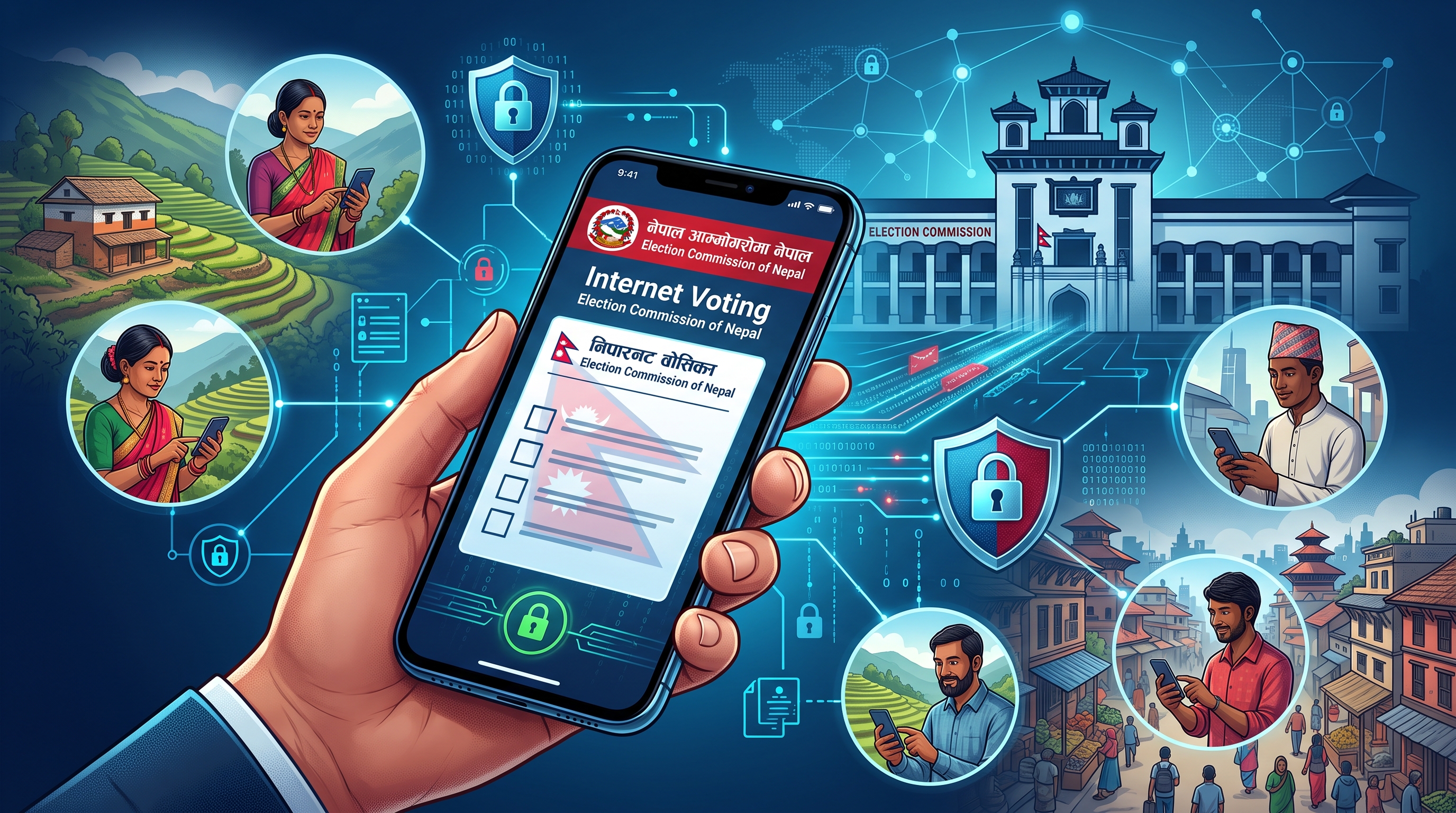
Nepal is taking another step toward technology-driven elections. The Election Commission has demonstrated internet-voting technology and says it plans to move toward internet-based electronic voting. But before Nepalis can cast ballots from their phones or computers, several major legal, technical and cybersecurity challenges must be solved.
Nepal explores internet voting
The Election Commission of Nepal organised a presentation, technology demonstration and interaction programme on internet voting technology on Tuesday, October 6, 2026.
Chief Election Commissioner Man Bahadur Karki said the Commission intends to move toward internet-based electronic voting. However, he also highlighted the need for technological preparation, institutional capacity, cybersecurity and coordination among relevant government agencies.
This means Nepal is not yet introducing nationwide online voting. Rather, the country is working toward creating the technical and institutional conditions that could eventually make internet voting possible.
Why is Nepal considering online voting?
One of the major reasons is the difficulty of providing voting opportunities to Nepalis who are living abroad or outside their registered constituencies.
The Election Commission has been discussing different models for allowing such citizens to participate in elections. Options include voting through diplomatic missions, postal voting, proxy voting, internet voting and mixed systems.
Internet voting could potentially allow an eligible voter to participate without physically travelling to a polling station.
For a Nepali working in Qatar, Malaysia, South Korea, Australia or another country, for example, an online voting system could eventually remove some of the logistical difficulties associated with travelling to a polling location or using traditional postal systems.
But convenience alone is not enough.
An election system must also guarantee that votes are authentic, secret, secure and accurately counted.
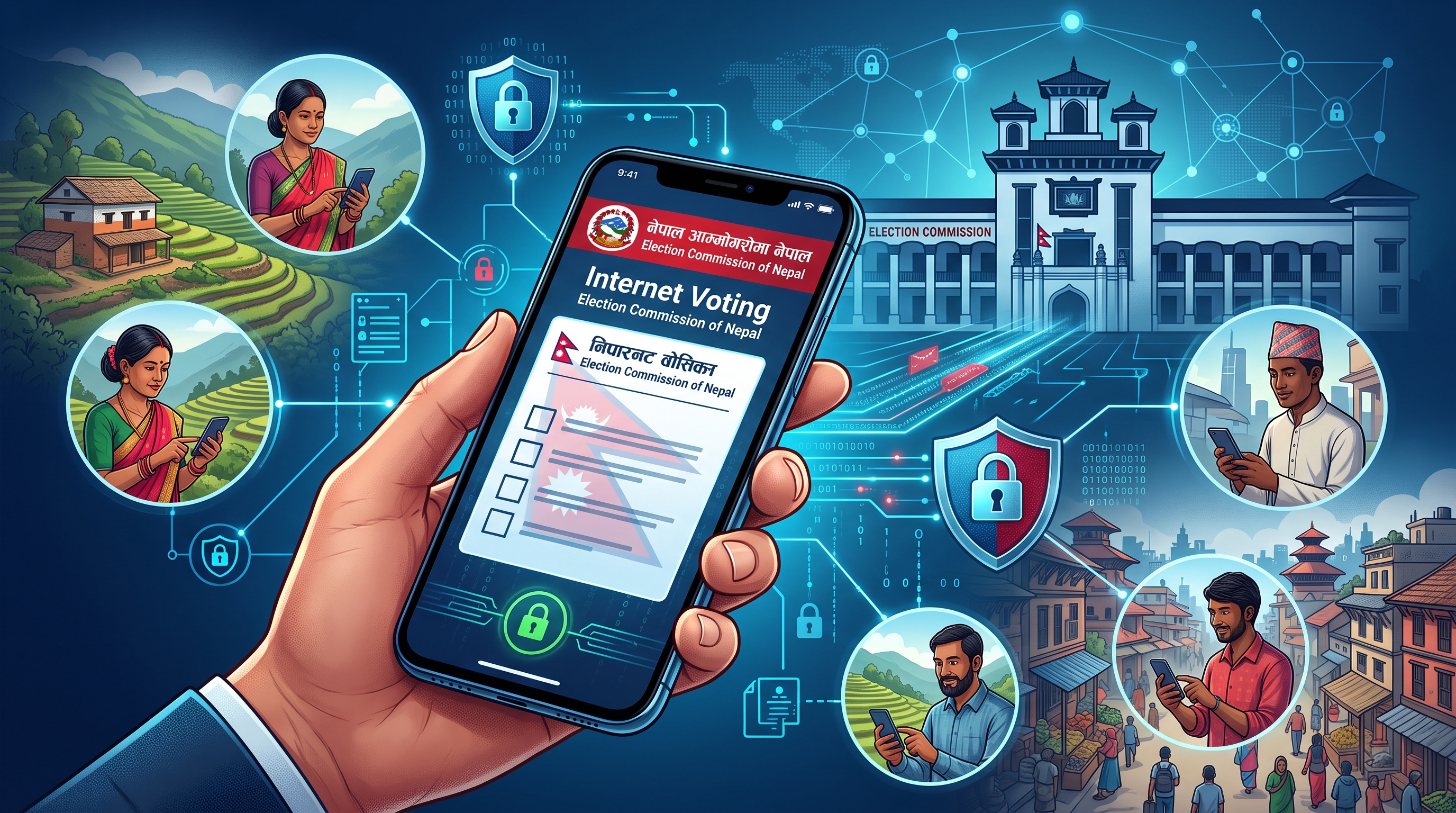
How could internet voting work?
A future Nepalese internet-voting system could involve several layers of technology.
1. Digital identity verification
First, the system would need to establish that the person attempting to vote is actually the registered voter.
This could potentially involve a government-issued digital identity, biometric verification, secure credentials or another form of multi-factor authentication.
2. Voter authentication
After establishing identity, the system would need to confirm that the voter is eligible to participate in that particular election.
The Election Commission has specifically identified digital identity and voter authentication as important technical areas that need to be addressed.
3. Secure ballot submission
The voter would then select their candidate or choice and submit the ballot through a secure system.
This is more complicated than a normal online form because the system must prevent someone else from discovering how a particular person voted.
4. Ballot secrecy
This is one of the hardest problems.
An election system needs to know whether a person is eligible to vote, but it should not allow authorities, hackers or other individuals to connect that person's identity with their actual vote.
In other words:
The system needs to know who you are without revealing what you voted for.
5. Verification and auditing
Finally, the election authority needs a reliable way to verify that the votes were recorded and counted correctly.
A digital election system therefore needs strong auditing mechanisms and independent security controls rather than simply relying on a website and database.
The biggest challenge: cybersecurity
Internet voting would create a completely different cybersecurity environment from traditional paper voting.
A conventional polling station has physical security, controlled access and paper ballots. An internet voting system would be exposed to digital threats such as:
- Hacking attempts
- Distributed denial-of-service attacks
- Malware
- Account theft
- Phishing
- Data breaches
- Insider threats
- Manipulation of election infrastructure
- Attempts to disrupt voting services
The Election Commission itself has identified cybersecurity, system development, infrastructure and operations as areas requiring specialised technical capacity.
This is why simply building an online voting website would not be enough.
Nepal would need a complete security architecture around the voting system.
What about internet access?
There is another important issue: digital inequality.
Not every Nepali has the same access to reliable internet, smartphones, computers or digital services.
If internet voting becomes available, the government would need to ensure that people who cannot or do not want to vote online are not disadvantaged.
That means traditional voting mechanisms may continue to be necessary even if online voting is introduced.
Could blockchain solve the problem?
Blockchain is sometimes presented as a solution for secure electronic voting.
Nepal's discussions around electoral reform have included proposals for secure internet voting using blockchain technology.
However, blockchain by itself does not make an election secure.
A blockchain can help with certain aspects of data integrity, but it does not automatically solve problems such as:
- stolen voter credentials,
- compromised devices,
- malware on voters' phones,
- coercion,
- identity verification,
- denial-of-service attacks, or
- ensuring that a voter can verify their ballot without compromising ballot secrecy.
So Nepal should not treat "blockchain voting" as a magic solution. The security of an internet election depends on the entire system, not one technology.
Nepal still needs legal reforms
Technology is only one part of the challenge.
The Election Commission has been discussing voting arrangements for Nepalis living abroad and voters outside their constituencies, but existing legal and administrative arrangements have been a significant obstacle.
New or amended laws, detailed procedures and clear responsibilities between government agencies would likely be required before internet voting could be implemented on a large scale.
Could Nepal eventually vote from a smartphone?
Technically, it is possible to build systems that allow people to authenticate themselves and submit digital ballots remotely.
But "technically possible" does not mean "ready for a national election."
For Nepal, the harder questions are:
Can the system withstand a major cyberattack?
Can voters trust the results?
Can ballot secrecy be guaranteed?
Can the system work reliably for millions of voters?
Can voters without smartphones or reliable internet participate equally?
Can the results be independently audited?
Those questions will matter more than simply whether Nepal can build an online voting application.
What happens next?
The Election Commission is now identifying the technical skills, human resources and institutional capabilities required for internet voting.
Commissioner Dr Rajiv Subba said implementation would require expertise across areas including digital identity, voter authentication, data exchange, cybersecurity, system development, infrastructure and operations.
That suggests Nepal's transition, if it happens, is likely to require multiple stages rather than an immediate nationwide rollout.
The country could first develop and test the infrastructure, establish the necessary legal framework, conduct controlled pilots and independent security assessments, and only then consider broader implementation.
The bottom line
Nepal's move toward internet voting could significantly change how citizens participate in elections, particularly for Nepalis living abroad or away from their registered constituencies.
But the biggest challenge will not be creating an app.
It will be creating an election system that people can trust.
Internet voting must combine secure digital identity, strong authentication, privacy protection, cybersecurity, reliable infrastructure, transparent auditing and an appropriate legal framework.
The Election Commission's October 6 technology demonstration is therefore better understood as a step toward exploring and preparing for internet voting—not the arrival of online elections in Nepal.
As Nepal becomes increasingly digital, the question is no longer simply whether technology can be used in elections.
The bigger question is whether technology can be used without compromising the fundamental principles of a democratic election.