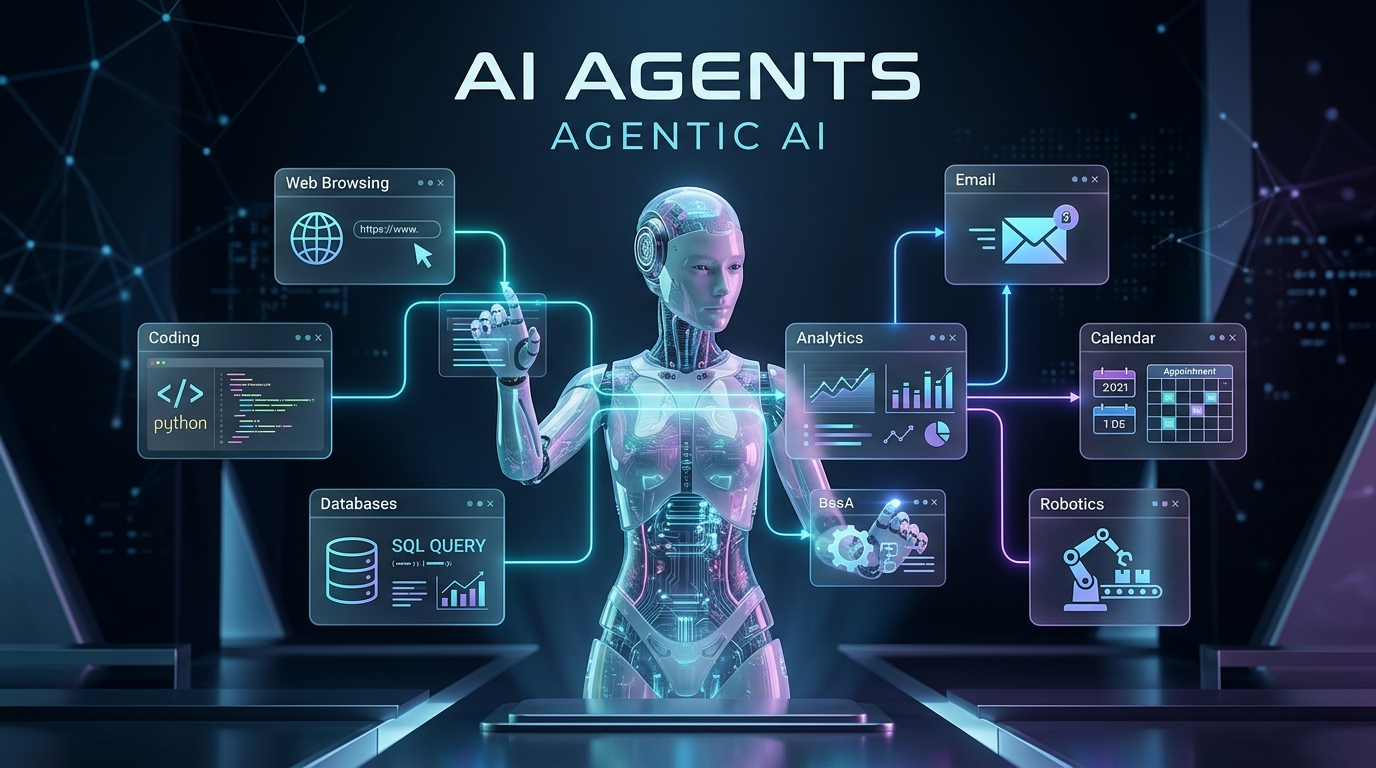


Imagine sitting down at your desk in the morning, opening your laptop, and simply typing: "Analyze the quarterly sales spreadsheet on my desktop, draft summary slides in Google Slides, email the draft to my team, and schedule a debrief meeting for tomorrow afternoon." Instead of spending the next three hours switching across browser tabs, clicking buttons, formatting cells, and writing emails, your computer quietly carries out each step on its own, asking for your sign-off only before sending the final message.
This is no longer science fiction. We are moving beyond passive chatbots like basic generative AI and stepping into the era of autonomous AI agents. For students, IT professionals, freelancers, and educators across Nepal and the broader global digital economy, understanding how AI agents work and learning to leverage them will redefine personal productivity, creative output, and workplace efficiency.
What Exactly Is an AI Agent?
To grasp the significance of this shift, we must distinguish between standard Large Language Models (LLMs) and AI Agents. A foundational language model functions like an immensely capable digital brain in a jar. It generates text, writes code snippets, and translates languages when prompted, but it cannot independently interact with software or take actions on your behalf.
An AI agent, by contrast, wraps that computational intelligence inside an action-oriented architecture. It couples the reasoning engine of an LLM with:
- Sensors / Perception: The capacity to read files, inspect browser Document Object Models (DOMs), read API responses, or even interpret screen pixels using computer vision.
- Planning & Reasoning: The ability to break high-level objectives into sequential milestones (often using frameworks like ReAct—Reasoning and Acting).
- Memory: Short-term memory (context windows) to track immediate progress and long-term memory (vector databases or local caches) to recall preferences, system configurations, and historical interactions.
- Actuators / Tool Use: The authority to invoke command-line scripts, query databases, control web browsers (via automated frameworks like Playwright or Selenium), and interact with operating system APIs.
Chatbots vs. AI Agents: A Quick Comparison
| Capability | Standard Conversational AI | Autonomous AI Agent |
|---|---|---|
| Primary Function | Answers queries, summarizes text, writes prose. | Executes multi-step goals across applications. |
| Action Execution | Cannot execute external commands directly. | Calls APIs, writes files, clicks buttons, runs code. |
| Self-Correction | Relies entirely on user re-prompting. | Inspects errors, recalibrates, and retries tasks. |
| Workflow Scope | Single-turn or turn-by-turn dialogue. | End-to-end task chains spanning multiple applications. |
How AI Agents Automate Common Everyday Tasks
Everyday knowledge work is filled with repetitive, cognitive "glue work"—transferring information from one interface to another, checking statuses, verifying data, and formatting reports. Here is how modern agentic systems tackle these workflows:
1. Intelligent Web Research and Synthesis
Traditional search requires you to open ten browser tabs, sift through advertisements, synthesize conflicting facts, and write your own notes. Autonomous web agents (such as Perplexity Pro agents or open-source frameworks like Browser-Use) handle this end-to-end. The agent searches Google, navigates directly to authoritative web pages, extracts statistical tables, compares viewpoints, and saves the verified synthesis directly to your Notion or Obsidian workspace.
2. Complex File Management and Data Wrangling
Locating, cleaning, and transforming disparate data files often drains hours of productivity. AI agents equipped with Python runtime environments can inspect your local directories, identify missing values in dirty spreadsheets, run data transformations, generate charting visuals, and compile PDF deliverables without requiring you to write a single line of formula syntax.
3. Email Inbox Triaging and Automated Response Preparation
Rather than relying on rigid email rules or regex filters, an AI agent understands context and urgency. It can:
- Read incoming client inquiries and verify relevant project details against your local documents.
- Draft context-aware replies ready in your "Drafts" folder for a one-click review.
- Flag high-priority legal or financial notices directly to your messaging channels.
- Extract dates, invoices, and deadlines, automatically adding them to Google Calendar or your task manager.
4. Cross-Platform Workflow Integration
Software ecosystems are fragmented: your team might use Slack, your university relies on Microsoft Teams, your documents reside in Google Drive, and your code sits on GitHub. Autonomous agents bridge these silos. Through tool use and REST APIs, an agent can observe a notification in one app, extract the relevant file, convert it, update a project management board in Trello or Jira, and log the completion timestamp across all platforms seamlessly.
The Core Architecture: How Do AI Agents Actually "Think"?
How does a software program take a vague command and convert it into accurate computer clicks and keystrokes? Most modern agents rely on a proven cognitive loop known as the Perceive-Plan-Act-Reflect cycle:
- Goal Formulation: The agent interprets user intent and creates an explicit success criterion (e.g., "Download invoice #1042 and file it under /Taxes/2024").
- Decomposition: It generates a task tree: Step 1: Open browser → Step 2: Navigate to vendor portal → Step 3: Authenticate → Step 4: Click download → Step 5: Move file to target directory.
- Execution (Tool Invocation): The agent executes Step 1 using a tool call (such as a headless Chromium instance).
- Observation & Error Handling: The agent reads the response. Did a CAPTCHA pop up? Did a network timeout occur? If an error appears, the agent does not panic; it uses its reasoning model to diagnose the problem, choose an alternative strategy, or politely alert the human user.
- Reflection & Termination: Once the file is verified in the correct folder, the agent terminates its loop and reports completion.
Practical AI Agent Tools You Can Experiment With Today
You don't need a PhD in machine learning to experience agentic automation. A vibrant ecosystem of both consumer-friendly tools and developer frameworks is available right now:
- Claude Computer Use (Anthropic): A pioneering developer API that enables Claude 3.5 Sonnet to view screen pixels, move mouse cursors, click buttons, and enter text directly into desktop interfaces.
- Cursor & GitHub Copilot Workspace: Highly specialized coding agents that don't just complete lines of code, but plan out multi-file refactors, run terminal commands, fix compiler bugs, and create pull requests autonomously.
- Zapier Central & Make AI: User-friendly platforms allowing non-technical professionals to link their favorite cloud apps with an AI reasoning core that executes automated workflows on triggers.
- Browser-Use / AgentQL: Open-source tools that empower developers to automate any browser-based task using natural language prompts rather than brittle web scrapers.
Key Challenges, Safety, and Limitations
While the potential of agentic computing is immense, widespread deployment introduces critical challenges that users and developers must navigate responsibly:
The "Infinite Loop" and Hallucination Risk
If an agent misinterprets a webpage layout or encounters an unexpected UI change, it can enter recursive loops, burning through API tokens and computing resources without making progress. Robust guardrails, timeout limits, and step budgets are mandatory.
Security and the Principle of Least Privilege
Granting an AI agent direct access to your local terminal, file system, or financial credentials introduces security vulnerabilities, particularly regarding indirect prompt injection. Malicious text hidden inside a webpage or email could secretly instruct an autonomous agent to leak confidential files or delete databases. Users should always implement a Human-in-the-Loop (HITL) model, where irreversible actions—such as making payments, deleting records, or sending emails—require explicit manual authorization.
"True autonomy without human verification is a recipe for catastrophic errors. The golden standard of modern AI agency is collaborative augmentation, not unsupervised delegation."
Conclusion: Preparing for an Agentic Future
The progression of computing has always moved toward higher levels of abstraction: from binary punch cards to assembly language, from command-line interfaces to graphical user interfaces (GUIs), and now, to natural language intent. AI agents represent the next giant leap in this trajectory.
For technology enthusiasts, university students, and business owners in Nepal, the goal should not be to fear automation, but to master the tools that power it. Start small: experiment with agent-driven search, automate your mundane file-sorting routines using open-source scripts, and build your literacy in prompt architecture and API integration. Those who learn to direct digital agents today will lead the productive, innovative workforce of tomorrow.